Running gets all the credit for cardio. But what if the workout that lifts your heart rate, torches calories, and leaves you smiling came with a net and a paddle? Pickleball and running both build a stronger heart, and they do it in very different ways. Here’s how they compare on calorie burn, joint impact, and staying consistent, so you can choose what suits you.
The Cardio Basics: What Your Heart Actually Needs
Before crowning a winner, it helps to know the target. The Canadian 24-Hour Movement Guidelines and the World Health Organization recommend at least 150 minutes of moderate-to-vigorous aerobic activity per week for adults. Meeting that benchmark is linked to lower blood pressure, better insulin sensitivity, improved cholesterol, and a lower risk of cardiovascular disease.
Exercise scientists measure intensity in METs (metabolic equivalents). Sitting quietly is 1 MET. Activity between 3 and 6 METs counts as moderate; above 6 is vigorous. Keep that scale in mind as we compare.
Calorie Burn and Intensity: Running Takes the Lead
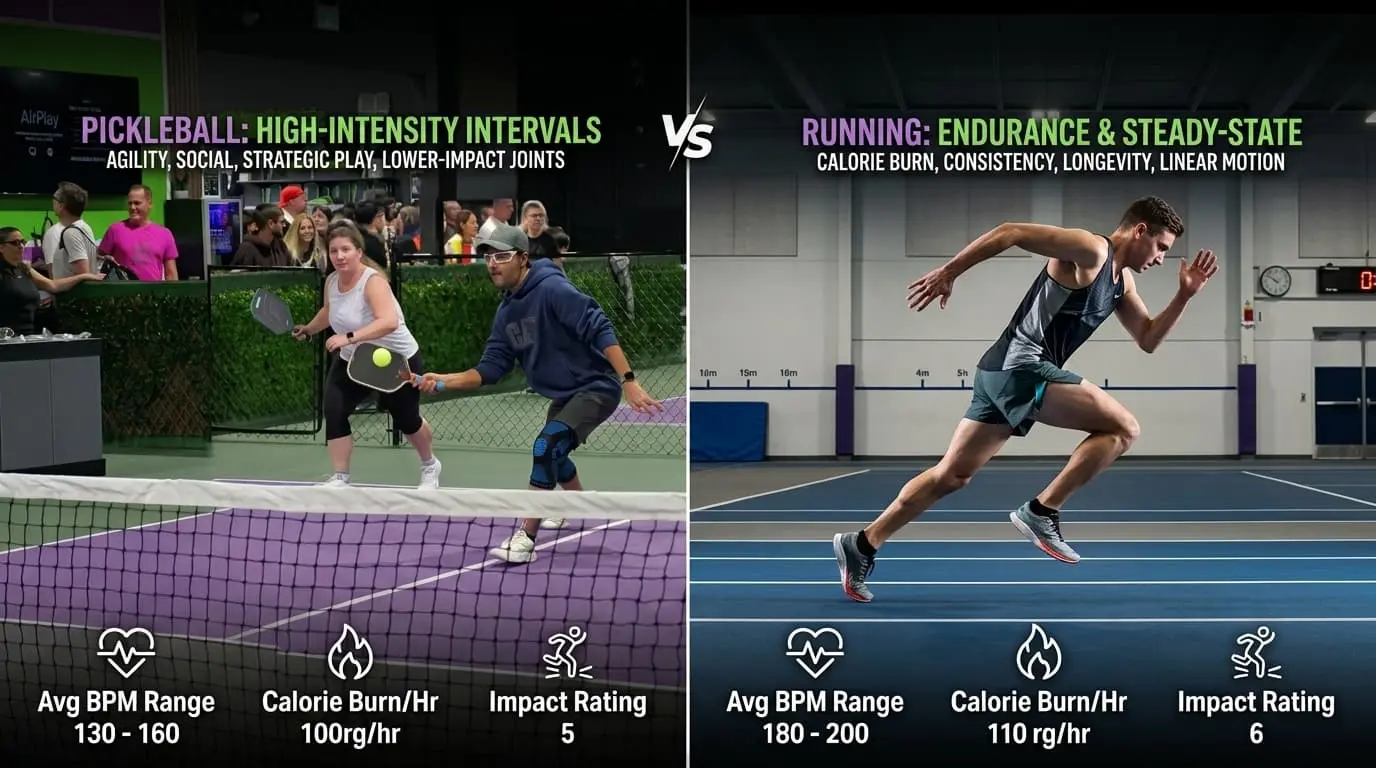
Let’s be fair to the runners. Per minute, running is one of the most efficient forms of cardio. Jogging at about 10 km/h sits near 10 METs, and a 70 kg person burns roughly 700 calories per hour, according to widely used estimates.
Recreational pickleball typically lands in the 4 to 5 MET range, or roughly 350 to 450 calories per hour for the same person, depending on skill level and how competitive the games are. Relaxed doubles sits at the lower end, while singles and fast rallies push higher.
Verdict on intensity: Running wins on raw calorie burn and time efficiency. If you have 30 minutes and want maximum cardiovascular stimulus, it’s hard to beat.
Heart Rate and VO2 Max: Closer Than You’d Think
Here’s where it gets interesting. Studies of pickleball players have found that regular play keeps heart rates in the moderate-intensity zone (roughly 60 to 75 percent of maximum heart rate), with spikes higher during fast exchanges at the kitchen line.
That matters because moderate-intensity activity is exactly what public health guidelines call for. Treating pickleball as a cardio workout is legitimate, especially for beginners, older adults, and anyone returning to fitness. The start-stop rhythm also mirrors interval training: short bursts of lateral movement, quick sprints to the net, and recovery between points.
Running, particularly with intervals or tempo efforts, is still stronger at raising VO2 max, the gold-standard measure of aerobic fitness. But for general heart health, moderate exercise done consistently delivers most of the benefit.
Joint Impact and Injury Risk: A Tale of Two Bodies
Running is a repetitive-impact activity. Each stride sends forces of roughly two to three times your body weight through your knees, hips, and ankles. Runner’s knee, shin splints, Achilles tendinopathy, and plantar fasciitis are common culprits, and running injury research reports high annual injury rates.
Pickleball isn’t injury-free. Ankle sprains, shoulder strain, and Achilles tears happen, especially when players skip warm-ups. But the court is smaller, the pace is lower, and the movement is varied rather than repetitive. Many people with mild joint concerns find it easier to sustain, though anyone with a diagnosed condition should check with a physician or physiotherapist first.
Verdict on joint health: Pickleball generally offers more variety and less repetitive strain, but a good warm-up and proper court shoes matter for both.
The Oakville Factor: Weather and Consistency
Here’s the reality for anyone in Halton Region: our winters are long. Ice, snow, early sunsets, and windchill make outdoor running a real test of willpower from December through March, and interrupted routines are the fastest way to lose fitness gains.
Indoor pickleball removes that barrier. Climate-controlled courts, good lighting, and non-slip surfaces mean your workout happens rain, snow, or shine. And adherence is where the sport shines. Research on exercise habits consistently shows that enjoyment and social connection predict long-term participation. A runner who quits after six weeks gets less benefit than a pickleball player who shows up three times a week for six years.
Pickleball also offers benefits running doesn’t:
- Hand-eye coordination and reaction time from tracking a fast-moving ball
- Lateral agility and balance, which support fall prevention as we age
- Cognitive engagement, since strategy and shot selection keep your brain active
- Social connection, linked in longevity research to better mental health and lower mortality
Mental Health: Endorphins, Community, and Stress Relief
Both activities trigger endorphins and lower cortisol. Running is meditative for many people, a way to clear the mind alone. Pickleball delivers a different kind of relief: laughter, friendly competition, and community. In the dark of a Canadian winter, when seasonal low mood is common, that social layer can be a real advantage.
So Which Is Better? It Depends on Your Goal
- Choose running if you want maximum calorie burn in minimal time, are training for a 5K or half marathon, or want to push your VO2 max.
- Choose pickleball if you want a lower-impact, enjoyable, sustainable routine that meets weekly cardio guidelines while building agility and friendships.
- Choose both for a well-rounded plan: run once or twice a week for aerobic power, and play pickleball for fun, footwork, and active recovery.
For most people, the honest answer is that running is the stronger pure cardio tool, but pickleball may be the stronger habit. And habits are what change your health.
Ready to Get Moving?
If a workout that feels like a game appeals to you, try it this week. Book a court for a beginner session, borrow a paddle, and play a few rallies. Once you’re hooked, sign up for pickleball league play to get regular matches, friendly competition, and a built-in reason to show up every week.
Start with two or three 45-minute sessions a week, warm up for five to ten minutes, wear proper court shoes, and stay hydrated. Track your heart rate with a watch if you like, and you’ll likely see your resting heart rate drop and your endurance climb within a couple of months.
The Bottom Line
Running and pickleball aren’t rivals so much as tools for different jobs. One is a lean, efficient engine for aerobic fitness. The other is a joyful, social way to keep moving all year long, whatever the Oakville forecast says. Pick the one you’ll look forward to, or better yet, combine them.
Disclaimer: This article is for general information and isn’t medical advice. Consult a healthcare professional before starting a new exercise program, especially if you have heart, joint, or other health conditions.