
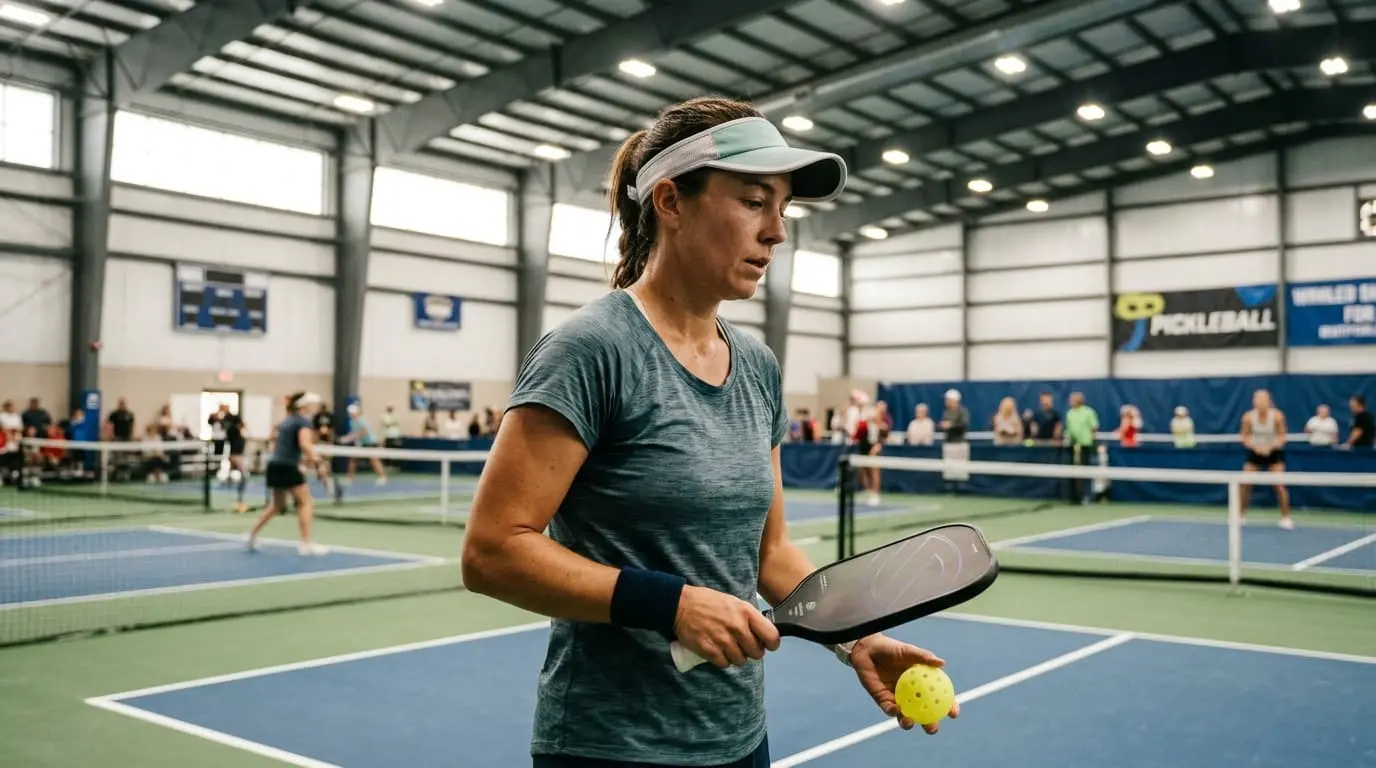
Game point. It’s 10–10, your palms are damp, and a tense dink rally at the kitchen line is stretching into its twelfth exchange. Your opponent pops one up an inch too high. Do you attack with a calm, compact swing, or do you squeeze the paddle and drive it into the net?
That split second has less to do with your forehand than with your nervous system. Elite players on the PPA Tour feel the same racing heart you do. The difference is a toolkit of mental habits that keep the prefrontal cortex in charge when the amygdala sounds the alarm. Here are six you can borrow at your very next match.
1. Build a Five-Second Reset Routine Between Points
Pressure grows in the gaps between rallies, not during them. Top players fill that gap with a short, repeatable ritual: a glance at the paddle face, one slow exhale, a quick check of the score, then a clear plan for the next serve. The whole thing takes about five seconds, yet it signals to your brain that every point is a fresh start.
Try it at your next side-out. Turn slightly away from the net, drop your shoulders, and breathe out. Then walk back to the baseline with purpose. Whether the last rally was a winner or a blunder, it is finished, and your routine closes the door on it.
2. Use Box Breathing to Lower Your Heart Rate
When stress spikes, adrenaline and cortisol flood your system, triggering the fight-or-flight response. Your grip tightens, your shoulders creep toward your ears, and the soft hands you need for a delicate dink disappear.
Elite players counter this with controlled breathing. In box breathing, you inhale for four counts, hold for four, exhale for four, and hold for four. Two rounds between points can noticeably slow your heart rate and loosen your grip. Finish with a long exhale just before you serve, and your swing will feel smoother almost immediately. Rehearse it on the couch first: a technique you have practiced calmly is one you can trust at 10–10.
3. Shrink the Game to One Shot at a Time
Nothing inflates anxiety faster than staring at the scoreboard. Elite players swap outcome goals (“I must win this game”) for process goals (“deep serve, third shot drop, patience in the kitchen”). Any certified pickleball coach will tell you the same thing: you cannot control the score, but you can always control your next decision.
Choose one process cue per game, such as “soft hands” or “split step,” and return to it whenever your mind sprints ahead. A game to 11, win by two, suddenly becomes a string of small, manageable choices instead of one overwhelming finish line.
4. Swap Harsh Self-Talk for a Coach’s Voice
Listen to your inner monologue after a missed volley. If it sounds like “You always choke,” you are feeding the stress response. Elite players rely on instructional self-talk instead: “Reset and stay low.” “Next ball.” “Trust the drop.”
A useful twist is to address yourself by name, the way you would encourage a doubles partner. Sport psychology research suggests this small bit of psychological distance helps regulate emotion. Keep phrases short, specific, and actionable so they guide your next move instead of replaying your last mistake. Write three go-to phrases on a card and tuck it in your paddle bag.
5. Visualize the Shot Before It Happens
Before a big serve or a tricky third shot drop, elite players mentally rehearse the ball’s arc, the paddle angle, and the landing spot just over the non-volley zone line. Visualization activates many of the same neural pathways as real play, which builds confidence and cuts hesitation.
Practice it off the court, too. Spend two minutes before bed picturing yourself winning a tense dink battle: staying patient, resetting hard drives, and choosing the right moment to speed up. Even thirty seconds during a changeover counts. When real pressure arrives, your brain will feel like it has been there before.
6. Treat Pressure as a Privilege, Not a Threat
Nervous energy and excitement look almost identical inside the body: a pounding heart, quick breathing, a buzz in your hands. Pros reframe the butterflies as readiness: “I’m nervous because this matters, and my body is prepared.” This cognitive reappraisal lets you use that arousal instead of fighting it.
Also normalize mistakes. Even the best players on the PPA Tour miss routine shots. What separates them is not a perfect record but the speed of their recovery. Miss, reset, move on.
Train Calm the Way You Train Your Dink
Mental skills behave like a third shot drop: they improve with deliberate repetition. Add one trick per week, test it in low-stakes recreational play, then carry it into league nights and tournaments. Training at a premier indoor pickleball club helps here, because steady lighting, no wind, and a competitive ladder let you recreate match pressure week after week.
So the next time the score is tied at 10–10, remember the sequence: reset, breathe, focus on one shot, speak kindly, see the ball, and welcome the pressure. Calm is not a personality trait. It is a skill, and you can start building it today.
Which trick will you try first? Tell your playing partners, compare notes after your next match, and watch how quickly your composure grows.